
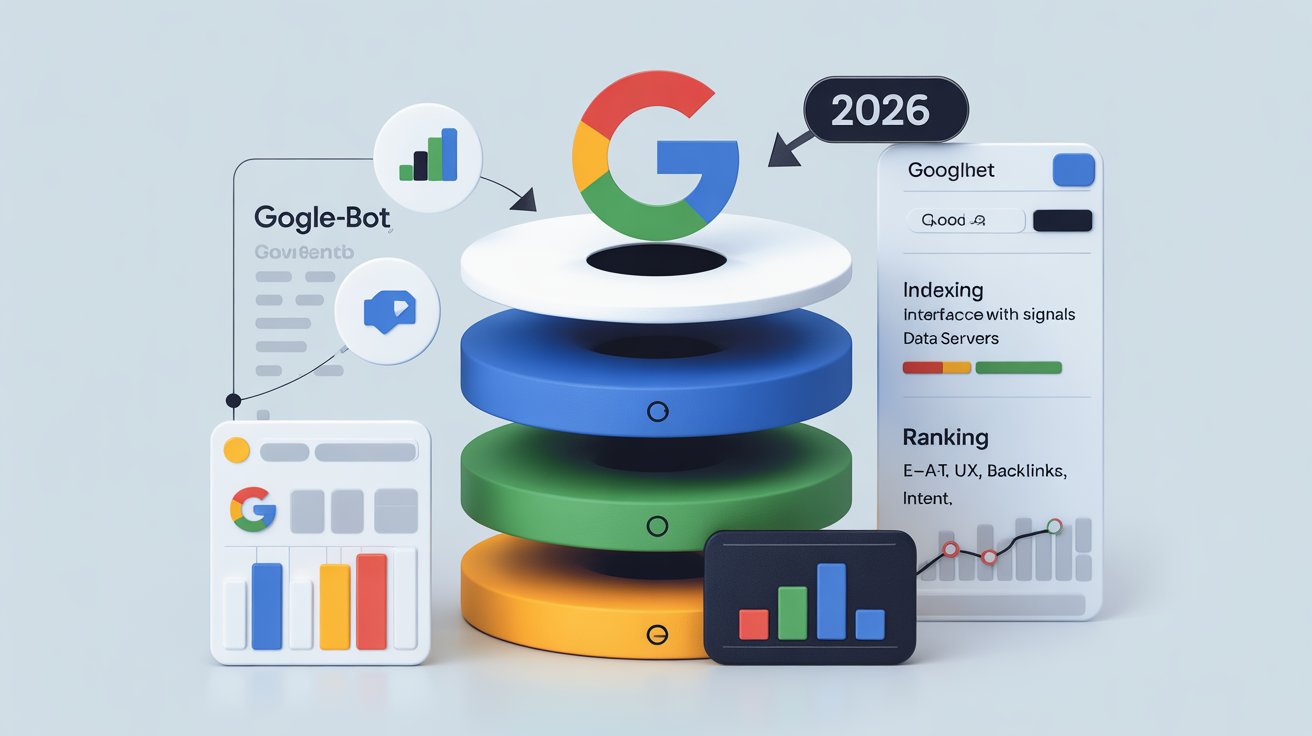
Google ranking system in 2026, Google’s ranking process is a multi-layered system that has shifted from purely keyword-based matching to deeply understanding identity, intent, and real-world human experience.
The ranking process follows three primary stages: Crawling, Indexing, and Serving.
Stage 1: Discovery (Crawling)
Before ranking can occur, Google must find your content.
- Discovery: Googlebot (a web crawler) finds new or updated pages through links on existing pages or sitemaps submitted via the Google Search Console.
- Prioritization: In 2026, Google prioritizes crawling for sites with established “Identity” and “Momentum”—verified businesses with consistent weekly updates are crawled more frequently than stagnant ones.
Stage 2: Storage & Analysis (Indexing)
Once a page is found, Google analyzes its meaning and stores it in a massive database called the Index.
- Rendering: Google renders the page (including JavaScript) to see it exactly as a user would.
- Quality Filtering: Low-value, “scaled” AI-generated content that lacks original insights may be filtered out or placed in a “sandbox” (a restricted indexing area) before it ever reaches the ranking stage.
- Entity Recognition: Google identifies the “entities” (people, brands, topics) on your page to determine if you are a recognized expert in your niche.
Stage 3: TheGoogle ranking system in 2026 (Serving)
When a user types a query, Google evaluates hundreds of factors in milliseconds to determine the order of results. This process is governed by several core pillars:
- Meaning & Intent Clustering: Advanced AI models like MUM, BERT, and RankBrain determine the intent behind the words (e.g., is the user looking to buy, or just learn?).
- E-E-A-T (Experience, Expertise, Authoritativeness, Trust): This is the foundation of quality. Google favors content from authors with verifiable real-world experience, especially for sensitive topics like health or finance.
- User Experience (Core Web Vitals): A mandatory technical requirement. In 2026, the Interaction to Next Paint (INP) metric is a critical signal, measuring how quickly your site responds to clicks or taps.
- Behavioral Signals (NavBoost): Google uses NavBoost to track how users interact with results. If searchers frequently click your link and stay on the page (high dwell time), Google interprets this as a “vote” for your quality and boosts your rank.
- Backlinks & Reputation: High-quality links from other authoritative sites act as “votes of confidence,” proving your site is a trusted source.
- Contextual Personalization: Results are tailored in real-time based on the user’s Location (Proximity), Device (Mobile vs. Desktop), and Search History.
To Beat Competitors in ranking Google ranking system in 2026 Focuses On These Things
Summary Checklist for Google ranking system in 2026
- Verify Identity: Use Google Business Profile and author schema to prove you are a real expert.
- Fix Technical Basics: Ensure your site loads in under 2.5 seconds and passes all Core Web Vitals.
- Focus on Depth: Replace short keyword-stuffed posts with “Topical Clusters” that cover a subject comprehensively.
Maintain Velocity: Google rewards sites that publish and update content consistently over a 3-4 month period.
Wanted More Information lets see how to use vibe coding just click down below: